Falling Asleep While Feeding Baby: A Solo Parent's Plan
If you might fall asleep while feeding your baby and there is nobody to hand them to, do not feed on the sofa or in an armchair. Feed in your bedroom, with the bassinet within reach and your side of the bed cleared of pillows and blankets before you pick the baby up. When the feed ends, the baby goes back on their back in their own space. If you wake and find you dozed, move the baby to their own space the moment you wake. That is the fallback the AAP and the NIH’s Safe to Sleep campaign describe: a plan for the night you cannot stay awake, not permission to bed-share.
A two-parent household can wake the other adult. You cannot, so the plan has to be built into the room before the night starts. Every source linked here was loaded and read on September 27, 2026. Nothing here replaces your pediatrician.
Why the sofa is the worst place to doze with a baby
The sofa feels like the careful choice. You go there because you are trying to stay awake. That is exactly why it is dangerous: it is where tired parents end up, and it is the surface the guidance ranks worst.
- The size of the risk. The AAP’s parent site says the risk of sleep-related infant death “is up to 67 times higher when infants sleep with someone on a couch, soft armchair or cushion.” The Academy’s announcement of its 2022 safe-sleep policy gives the same figure.
- Why it happens. Safe to Sleep explains that on soft surfaces, couches and sofas included, babies “may not be able to breathe due to entrapment or wedging, suffocation, or strangulation.”
- Why solo parents sit in the worst row. Safe to Sleep’s risk list puts two things in its “very high risk” tier: a soft surface such as a “couch, or armchair,” and an adult who “is very tired, taking medication that makes them drowsy, or using substances like alcohol.” Three weeks of broken nights makes you the very-tired adult. At 3am on the couch, you tick both.
What the AAP and Safe to Sleep say to do
The official position comes first. The AAP recommends room-sharing without bed-sharing, with the baby’s own crib or bassinet “close to your bed—but not in the same bed” for at least the first six months. When the 2022 policy came out, co-author Dr. Rebecca Carlin said “AAP cannot support bed-sharing under any circumstances.” Nothing below changes that.
The guidance also plans for the night a tired parent falls asleep anyway. The AAP’s parent guide to safe sleep says:
“If there is any possibility that you might fall asleep while your baby is in your bed, remove pillows, blankets, sheets and other items that could cover your baby’s face, head or neck or lead to overheating. If you do fall asleep, be sure to move your baby back to their own sleep space as soon as you wake up.”
It follows with “Avoid falling asleep with your baby in other spots, too” and then the couch figure. Safe to Sleep’s breastfeeding and safe sleep page adds the step most people skip: “think about how tired you are before you start a feeding session.” It suggests asking someone to stay with you and wake you if you doze. Then comes the line written for a house like yours: “If you don’t have someone to help you stay awake, set a timer to go off every few minutes to keep you awake.”
So the order is: the baby’s own space first, a cleared adult bed as the fallback, never the sofa. Betteroo has a room-by-room walkthrough of the bare-crib setup if you want the whole bedroom checked.
Set up the room so the safe choice is the lazy one
At 3am you will do whatever takes the fewest steps, so give the safe option the fewest steps.
- All night feeds happen in the bedroom. Not the living room, not the nursery armchair. Nights should not involve walking, the same rule behind bringing a newborn home alone.
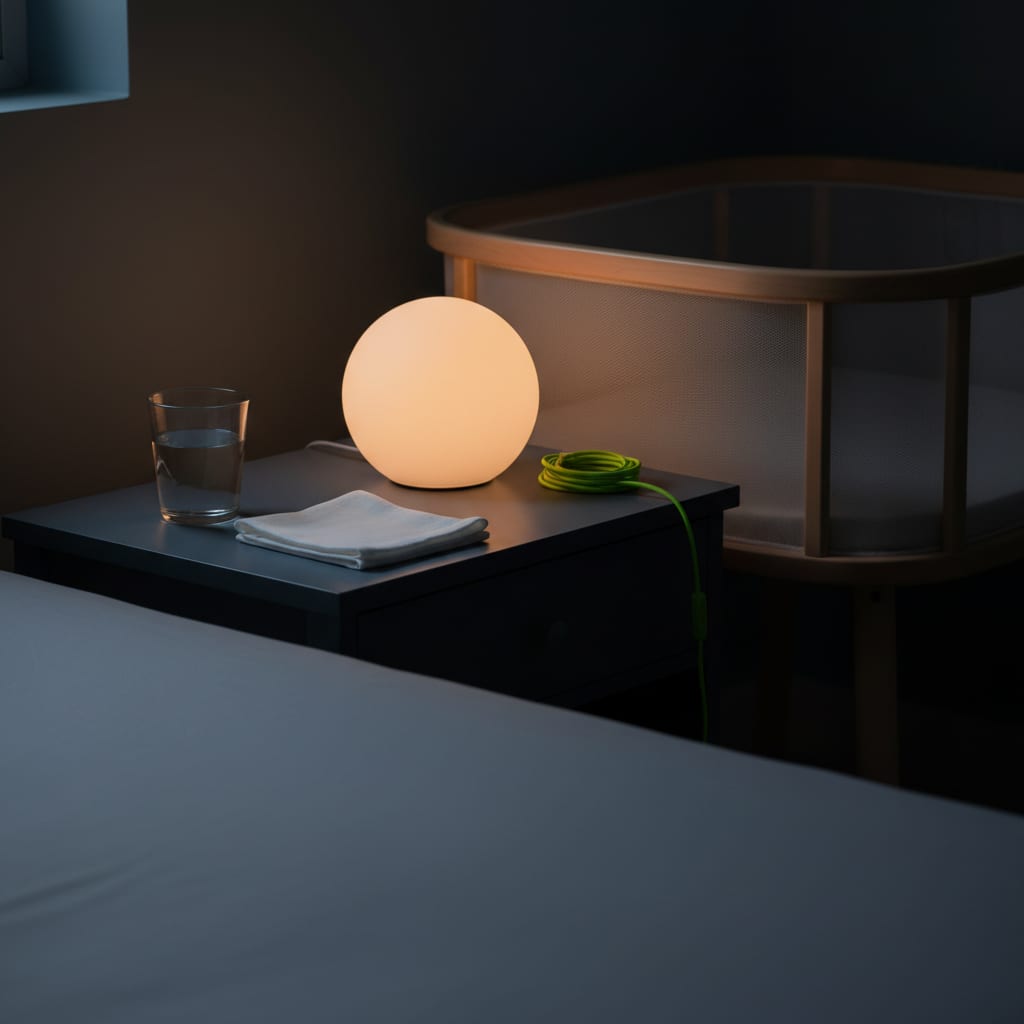
- Bassinet at arm’s reach from where you feed. Returning the baby should be easier than keeping them. A model that swivels over the mattress edge, like the HALO BassiNest Swivel Sleeper, is one worked example. Whatever you use, the AAP’s rule is a crib, bassinet or play yard that meets the CPSC’s federal safety standards, with a fitted sheet and nothing else.
- Clear your side before you pick the baby up. Pillows and the comforter go off your side and away from where the baby will be. Ten seconds while you are awake; impossible once you have dozed.
- Stock the nightstand. Water, a burp cloth, a lamp you can switch on one-handed, and your phone with the timer ready. Nothing left to get up for.
- Set the timer before you need it. A repeating alarm every few minutes, as Safe to Sleep suggests, loud enough to actually wake you.
The daytime version: the sofa while you are awake
The warm afternoon feed on the couch is where many tired parents actually drift off. Safe to Sleep’s advice covers it: if there is any chance you might fall asleep, avoid feeding on couches and armchairs.
Holding a sleeping baby is not the risk. Your eyes closing is. Betteroo’s guide on why a nap on your chest is fine and a doze on the sofa is not gives the working rule: “If you feel yourself getting drowsy, put your baby down.” Treat the first heavy blink as the signal.
What raises the risk further
The AAP names situations where it is “extra important” not to fall asleep with your baby. Several are likelier when you are the only adult:
- Drowsy medicine. The risk is “more than 10 times higher for babies who bed share with someone who is fatigued or has taken medications that make it harder for them to wake up.” Sick solo parents take cold medicine; if you have, plan a night with no dozing on any surface, and read the solo-parenting-while-sick plan before you need it.
- Alcohol, marijuana or other drugs.
- Smoking or vaping, now or during pregnancy.
- A young or small baby. The bed-sharing risk is “5 to 10 times higher” under four months, and “2 to 5 times higher” for babies born preterm or at low birth weight.
If you wake up and the baby is on you
Move them to their own sleep space, on their back, as soon as you wake. Then do two things before the next feed.
Find the step that failed. Room not set up, timer off, feed outside the bedroom? A missing step can be fixed.
Tell someone. Falling asleep at most feeds is not a willpower problem. It means the load is too much for one adult, and your pediatrician and your own doctor should hear it. Then shrink the load: go to bed when the baby does, ask a friend to cover one daytime stretch a week while you sleep in a real bed, and once your pediatrician says your baby is ready, look at night weaning as a solo parent to cut the feeds you must stay awake through.

FAQ
Is it safer to fall asleep with my baby in bed than on the couch? The AAP does not recommend bed-sharing at all. Its fallback for a tired parent is a bed cleared of pillows and blankets, with the baby moved back the moment you wake. It never offers the sofa as a fallback, and gives the couch figure (up to 67 times higher risk) as a separate warning.
Does a glider or recliner count as an armchair? Treat it as one. A padded feeding chair is fine while you are fully awake. Once you feel drowsy, the baby goes down.
Does this apply to bottle feeding too? Yes. The surface rules are about where an adult falls asleep with a baby, however the baby is fed. Safe to Sleep’s wording covers “feeding, comforting, or snuggling.”
My baby only sleeps on me. What now? Holding a sleeping baby while you are awake is normal. The line is your own drowsiness. When you feel it, move the baby to their own space, even if they wake. A few more minutes of resettling is a better trade than dozing on the sofa.