Bringing a Newborn Home Alone: The Solo Playbook
Bringing a newborn home alone is a logistics problem before it’s an emotional one, and it comes down to four decisions you make before you’re tired: where you’ll sleep so that nights don’t require walking, what’s within arm’s reach in every room you’ll get stuck in, who comes through the door in the first two weeks, and what your one protected sleep block is. Nobody is coming to take a shift, so the plan can’t depend on one. What follows is the operational version — the setup, the night shift, the safety lines that don’t bend, and the signs that mean pick up the phone.
Before you leave the hospital: the list to clear
Do these while you still have nurses within shouting distance.
- Book the ride, and a backup driver. You can’t drive yourself home, and after a cesarean you won’t be cleared to drive for weeks.
- Get the car seat checked by someone who does it for a living. Ask before discharge day; many hospitals and fire departments have a certified technician.
- See a lactation consultant before discharge if you’re feeding that way, even if it’s going fine. A latch is easier to fix on day two than day twelve, and many insurance plans cover outpatient lactation support — confirm yours rather than assuming.
- Leave with the pediatrician appointment booked — usually within a few days — and the after-hours nurse line saved in your phone under a name you’ll recognize at 3am.
- Ask who to call for what: which number for a baby question, which for a you question. Both on the fridge, because a tired brain does not search.
The night shift of one
The goal is not eight hours. The goal is one protected consolidated block, and everything else is triage around it.
Newborns typically feed eight to twelve times in twenty-four hours, and their longest stretch usually falls in the early part of the night. Which means the highest-value move available to a solo parent is unglamorous: go to bed when the baby does, at 8pm, not at midnight after the dishes. The dishes are not load-bearing. That first stretch is the only sleep you’re guaranteed, and staying up to reclaim your evening is the single most common way people arrive at week three destroyed.
Two engineering decisions make the nights survivable:
Sleep in the same room, so nights don’t require walking. A separate flat firm surface next to your bed — bassinet or crib — is what Safe to Sleep and the AAP recommend anyway, and for a solo parent it also removes the corridor walk that wakes you fully every time.
Make the couch a hard no. The most dangerous place to fall asleep with a newborn is a sofa or armchair, and an exhausted parent feeding alone at 4am is exactly who ends up there. If there’s any chance you’ll doze, feed in a bed cleared of pillows and loose blankets, and put the baby back on their own surface after. This is the one rule on this page with no flexible version.
It also helps enormously to know what the nights are supposed to look like, so you stop grading yourself against a fantasy. Newborn sleep runs on very short awake stretches — how long a newborn can actually stay awake is measured in minutes, not hours, and missing that window is the usual cause of a baby who won’t go down at 9pm.
If you’d rather not assemble any of this yourself in the first fog, the Betteroo plan-builder generates an age-matched routine from a short questionnaire and updates it as the baby grows. For a solo household the value is that it removes the decision-making, not the work — it’s a plan you follow rather than one more thing to research at 2am.

Stations: engineering a one-adult apartment
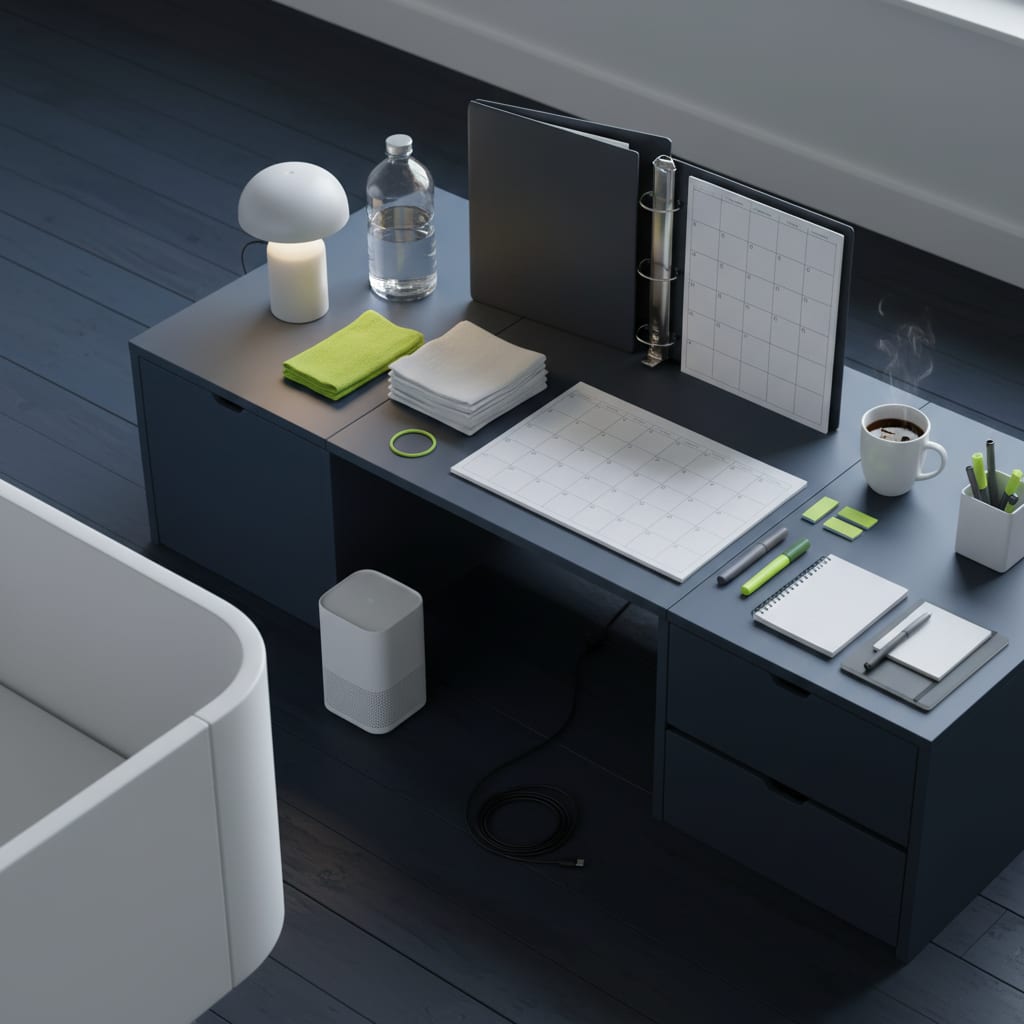
You will get pinned under a sleeping newborn for forty minutes at a time, and whatever isn’t within arm’s reach is unavailable. So stock three stations before the baby arrives:
Bedside: diapers, wipes, two changes of clothes, burp cloths, a large water bottle, one-handed snacks, phone charger, a dim lamp. Dim light at night, bright light in the morning — that’s how day-night confusion resolves.
Main living area: the same kit again. Duplication feels wasteful and costs about one afternoon of sanity to skip.
Bathroom: your postpartum supplies, plus a safe place to set the baby down while you shower — a bouncer or the crib. The shower is not optional and does not require another adult.
Add one piece of hardware if you add anything: continuous white noise, which covers the street, the neighbors and your own household noise. A mechanical unit like the Yogasleep Dohm does it without a screen, an app or a battery to die, and doubles for your own daytime sleep later.
Feeding decisions that buy back minutes
Whatever method you choose, evaluate it on one solo-specific axis: how many minutes of hands it costs at 3am.
- Breastfeeding costs no preparation but all of your hands. Side-lying feeding in a safe bed, learned early from a lactation consultant, is the biggest sleep upgrade available.
- Bottle feeding costs preparation, so move it to daylight: everything washed, assembled and lined up before bed, water measured, one fewer decision in the dark.
- Mixed feeding is a legitimate choice, and for a solo parent it sometimes buys the difference between coping and not.
Set the bar at fed, safely, by a mother who slept a bit.
Your body is a patient too
You are recovering from a major physiological event, alone, with no one to notice you’ve gone grey. So build recovery into the plan the way you’d build in a feed: water within reach at every station, real food someone else prepared for the first two weeks, and no lifting anything heavier than the baby after a cesarean until you’re cleared.
Keep the postpartum checkup even if you feel fine — especially if you feel fine, because blood pressure problems after birth are common and quiet. And schedule the sixth-week help now: crying commonly peaks around six weeks, the casseroles have stopped by then, and that is the week the plan gets tested. Who fills which slot is worth deciding in advance — the roster is in building your village from day one.
The calls worth making immediately
For you, urgently: bleeding that soaks a pad in an hour, a fever, a severe headache or vision changes, chest pain or trouble breathing, pain or swelling in one calf. Any of these is an emergency room, not a wait-and-see.
For the baby, urgently: a rectal temperature of 100.4°F or above in a baby under three months, difficulty breathing, refusing to feed, no wet diapers, or deepening yellow skin. Under three months, fever is an ER visit, not a morning call.
For your head: intrusive thoughts about harming yourself or the baby, or a flatness that doesn’t lift, are medical symptoms and treatable ones. The National Maternal Mental Health Hotline is 1-833-TLC-MAMA (1-833-852-6262), free and staffed 24/7, and 988 is there for a crisis. Solo parents delay this call longer than partnered ones, for the obvious reason: nobody else is in the room to notice. The signs worth watching for over the following months are in single mom burnout, and the day eventually reshapes itself into something repeatable — a working weekday template is what it looks like on the far side.
FAQ: bringing a newborn home alone
How long is the hardest part? Roughly the first six to eight weeks, with crying commonly peaking around six weeks and easing after. Longer nights usually arrive somewhere in the second or third month. That’s a range, not a promise.
Can I shower? Yes. Put the baby somewhere safe — crib, bassinet or bouncer on the floor, never a bed or sofa — and shower. A safely placed crying baby for eight minutes is not a harm.
What if I have nobody to call for the first two weeks? Buy the coverage you can’t borrow: a postpartum doula for targeted hours, grocery delivery, a cleaner once. And arrange it before the birth, because arranging anything during week one won’t happen.
What do I say when someone offers to help? Something specific and bounded: hold the baby for an hour at 6pm Tuesday, bring dinner Thursday, take the trash out. Vague offers die of vagueness; specific ones get honored.