The 3-4-4-3 Custody Schedule: Calendar, Pros and Cons
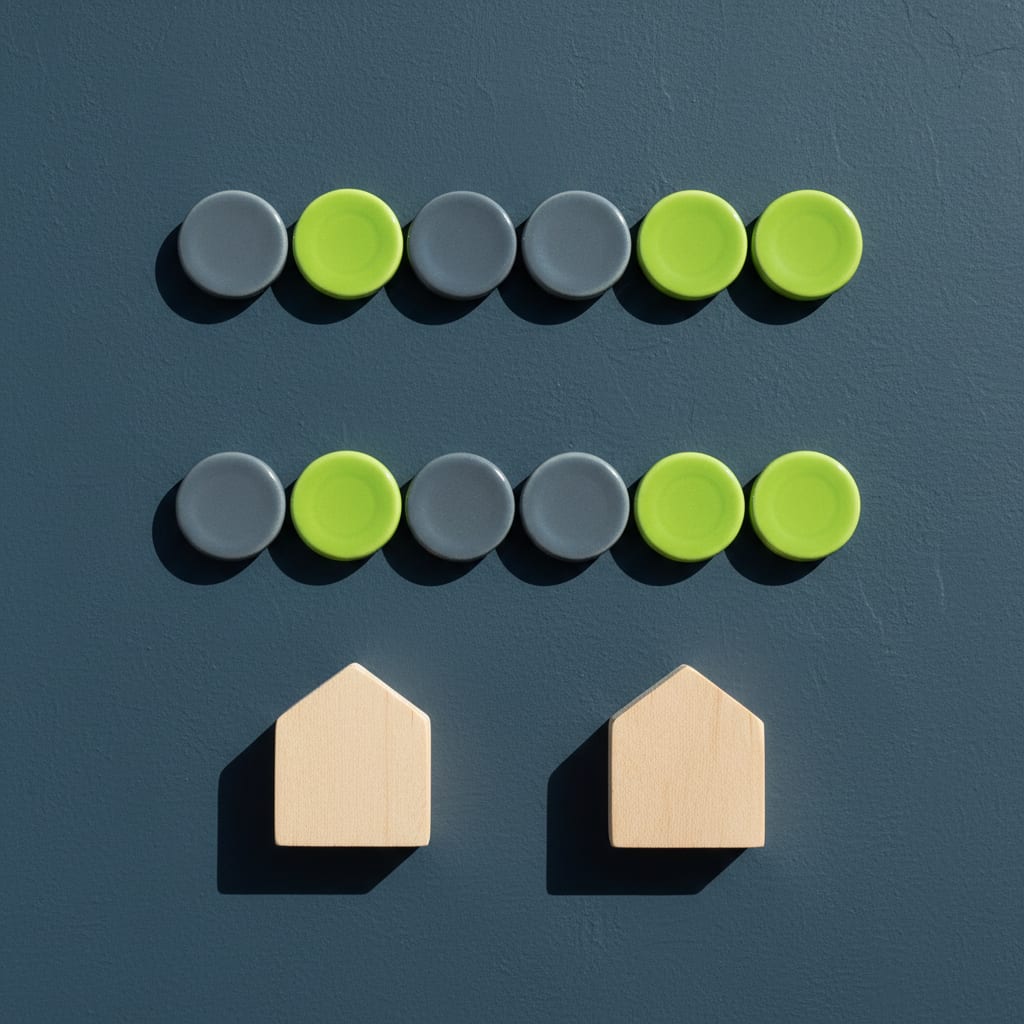
A 3-4-4-3 custody schedule is a 50/50 rotation where one parent has the kids for three nights and the other for four, and then the next week it flips: four nights, then three. Each parent gets 7 of every 14 nights, nobody goes more than four nights without the kids, and each parent keeps the same three nights every week. Only one night changes hands from week to week, the swing night. That gives two exchanges a week and a calendar you can hold in your head.
The tables below show where the child sleeps each night. Parent A and Parent B have equal time. A handoff at school pickup or drop-off counts as an exchange, even if the parents never see each other.
The classic 3-4-4-3, starting Sunday
| Night | Week 1 | Week 2 |
|---|---|---|
| Sunday | A | A |
| Monday | A | A |
| Tuesday | A | A |
| Wednesday | B | A |
| Thursday | B | B |
| Friday | B | B |
| Saturday | B | B |
Read the rows, not the columns. A has Sunday, Monday and Tuesday every week. B has Thursday, Friday and Saturday every week. Wednesday is the swing night: B’s in Week 1, A’s in Week 2. That’s the whole schedule: 3-4 in Week 1, 4-3 in Week 2.
The arithmetic: A has 3 + 4 = 7 nights, and so does B. Exchanges happen on Wednesday in Week 1, Thursday in Week 2, and Sunday in both, so that’s 4 per two weeks. The midweek one can run through school; the Sunday one is an in-person handoff. The longest stretch away from either parent is four nights, B’s Wednesday-to-Saturday run and A’s Sunday-to-Wednesday run.
OurFamilyWizard’s guide to the schedule suggests a Sunday start so each parent gets a weekend day. It’s true in daylight hours. Overnight, though, B has every Friday and Saturday night and A has every Sunday night, so B gets the weekend nights every week. Decide whether that’s fine before you sign, not in month three.
The school-week version, starting Monday
| Night | Week 1 | Week 2 |
|---|---|---|
| Monday | A | A |
| Tuesday | A | A |
| Wednesday | A | A |
| Thursday | B | A |
| Friday | B | B |
| Saturday | B | B |
| Sunday | B | B |
Here the swing night is Thursday, and B has every Friday, Saturday and Sunday night. A has the school week. It’s the right shape when A works weekends or B works long weekday hours. Every exchange can run through school: B drops off Monday morning, and A drops off Thursday or Friday morning for B to collect. The parents never need to meet.
The cost is blunt. A never has a weekend night with the kids, and B never does a Monday school morning. Over a year, that division of fun time and homework time builds resentment in a lot of families.
The swing-Saturday version, starting Wednesday
| Night | Week 1 | Week 2 |
|---|---|---|
| Wednesday | A | A |
| Thursday | A | A |
| Friday | A | A |
| Saturday | B | A |
| Sunday | B | B |
| Monday | B | B |
| Tuesday | B | B |
Move the start to Wednesday and the swing night becomes Saturday, so the parents alternate Saturday nights. A always has Friday night and B always has Sunday night, and every other Saturday belongs to each. This is the fairest 3-4-4-3 for weekends.
The trade is that the weekend handoff moves: Saturday in Week 1, Sunday in Week 2, where the classic version always hands off on Sunday. Saturday activities also move between houses. If a predictable handoff matters more than fair Saturdays, the classic version is easier to live with.
How it compares with the other 50/50 rotations
| Schedule | Longest stretch away | Exchanges per 2 weeks | Fixed weeknights? | Weekends |
|---|---|---|---|---|
| 2-2-3 | 3 nights | 6 | No, they flip weekly | Alternate |
| 3-4-4-3 | 4 nights | 4 | Yes, except the swing night | Depends on start day |
| 2-2-5-5 | 5 nights | 4 | Yes | Alternate |
| Week on/week off | 7 nights | 2 | No | Alternate |
The useful comparison is with the 2-2-5-5. Both have four exchanges per fortnight and fixed weeknights. The 3-4-4-3 cuts the longest gap from five nights to four. The 2-2-5-5 alternates whole weekends cleanly, and in the 3-4-4-3 only the start day decides who gets which weekend nights. If alternating weekends is non-negotiable, the 2-2-5-5 does it without a workaround. If four nights is the most your youngest can manage away from either of you, the 3-4-4-3 wins.
Who it fits
- Homes close together. Two exchanges a week, and one is midweek. OurFamilyWizard’s guide puts the comfortable distance at about 10 to 15 miles, beyond which “commuting becomes a significant hassle.”
- Stable work schedules. The same three nights every week lets each parent build work and childcare around them. Danielle Kestnbaum, J.D., M.S.W., quoted in the same guide, notes this can cut childcare costs where, for example, “one parent has Mondays off while the other has Saturdays off.”
- Kids who don’t do well with long gaps. Four nights is the ceiling, without the 2-2-3’s six handoffs.
- Not for co-parents who can’t sit in the same bleachers. Because the weeknights are fixed, a weekly Thursday game always falls to the same parent. Kestnbaum’s warning in the guide is that the other parent “might miss all football games” if they can’t attend together.
Put the swing night in writing
Most 3-4-4-3 arguments are about the one night that moves. Write it into the plan precisely: which parent has the swing night in Week 1, against a named start date, the exchange time and place for each handoff, and what happens when the swing night lands on a holiday. The co-parenting schedule hub has the full set of schedules side by side if you’re still choosing.
One tax detail that comes with exact 50/50. A year has 365 nights and a two-week rotation covers 364, so one parent usually ends up with 183 nights and the other with 182. IRS Publication 504 (loaded October 11, 2026) makes the parent with more nights the custodial parent. If the nights really are equal, it says “the custodial parent is the parent with the higher adjusted gross income.” That one night decides who can claim the child unless a release is signed, so count it. Have a family-law attorney where you live review any schedule before it goes into a plan or order. This is a logistics post, not legal advice.
FAQ: the 3-4-4-3 schedule
Is 3-4-4-3 a 50/50 schedule? Yes. Each parent has 7 of every 14 nights. It’s sometimes confused with a 4-3 every week, which gives the same parent four nights each week and works out to about 57/43.
How many exchanges does a 3-4-4-3 have? Two a week, four per two-week cycle: one on the start day and one on the day after the swing night.
What’s the best start day? Sunday for a fixed Sunday handoff, if one parent holding the Friday and Saturday nights is fine. Wednesday if alternating Saturdays matters more. Monday if you want every handoff to run through school and one parent genuinely wants every weekend.
Is 3-4-4-3 good for toddlers? It’s one of the shorter-gap 50/50 options, with four nights at most. For a baby or young toddler, a 2-2-3’s three-night ceiling is shorter still, at the price of more handoffs.