One Sleep Plan, Two Houses: A Co-Parent's Setup

Running one sleep plan across two houses is a setup problem, not a persuasion problem. You need three physical things — a written one-page plan both homes work from, a duplicated sleep kit so nothing depends on a bag, and a handoff routine that sends the same items every time — plus one agreement: who updates the plan, and when. Get those in place and most cross-house sleep arguments stop happening, because there’s nothing left to remember differently. Here’s the setup, including the version where only your house is on board.
The plan sheet: the eleven lines that end most arguments
Two decent homes produce one wrecked sleeper because both are running from memory, and memory reconstructs. A single dated page fixes it. Eleven lines, fridge-sized:
- Child’s age, and the date this version was written. A plan without a date turns into folklore.
- Wake time — the target, not the hopeful one.
- Nap times and lengths, or wake windows if you’re not on a clock yet.
- Bedtime, one time, both houses, within about 30 minutes.
- The routine sequence — four or five steps in order, no decor requirements.
- The settling method, named plainly: rocked to sleep, put down drowsy, checks at intervals.
- Night wakings — what each house does at 2am, in one sentence.
- Overnight feeds, if any, and roughly when.
- The skipped-nap rule — usually: move bedtime earlier, not later.
- The sick rule — what suspends the plan, and when you go back to it.
- Who updates it, and on what trigger. Name a person: “Marisol updates it when naps change.”
Deliberately boring, because boring survives contact with a co-parent who thinks sleep science is a personality trait. Keep it in both kitchens and version it — “v3, July 31” — so nobody argues about which is current. If you keep a shared rotation, staple it to that; the co-parenting calendar template is where mine lives.
The other route, when writing it yourself is one job too many: let a tool generate the plan and hand that over. Betteroo’s sleep planner builds a day-by-day, age-matched plan from a short questionnaire and updates it as your baby grows. For two-household setups the value is the authorship: a plan neither parent wrote is one neither parent has to lose an argument to. It’s a tool, not a treaty — it can hand both homes the same page, it can’t make the other house open it.

What to duplicate, what travels, what stays put
Sort every item into a bucket once, then never revisit it at 6pm on a handoff night.
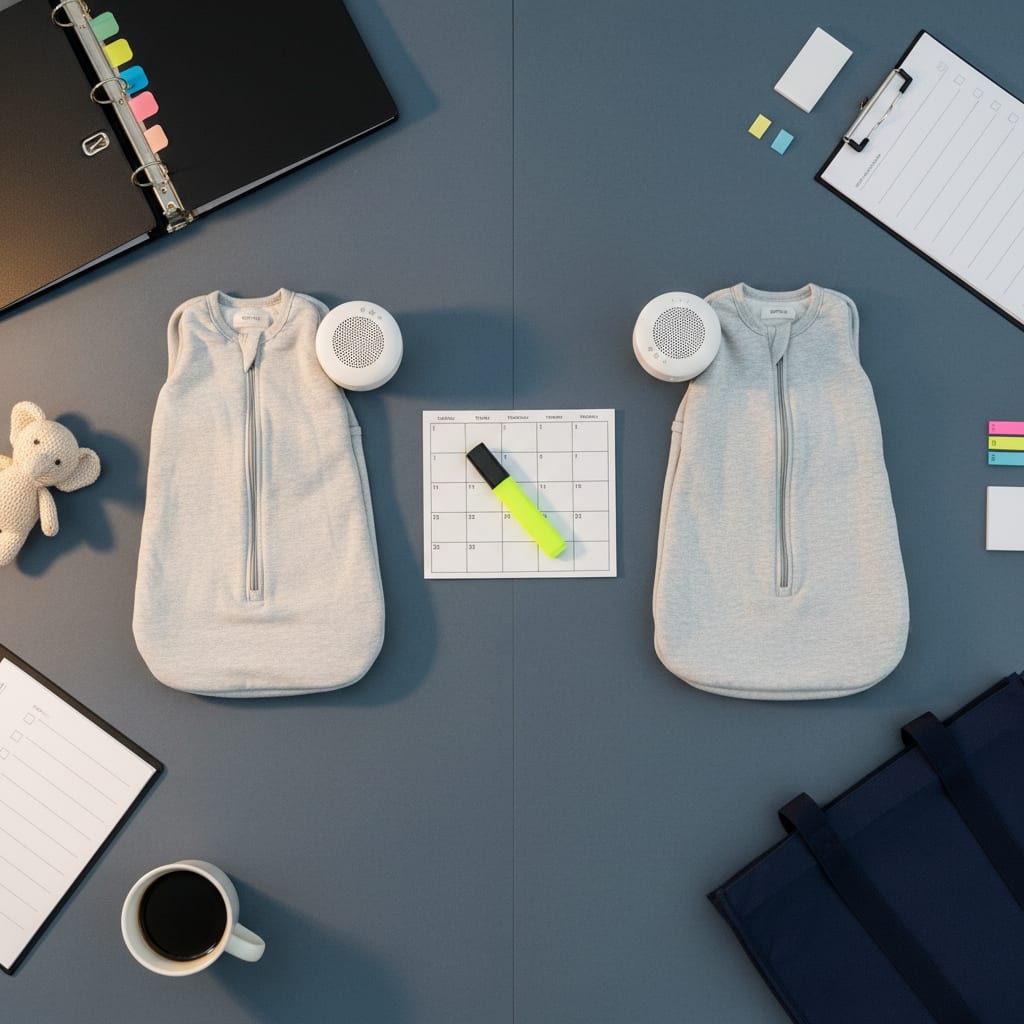
Duplicate — buy two, one per house:
- The sound machine. Cheap, decisive, and the item most often left in the wrong kitchen. A fan-based unit like the Yogasleep Dohm holds a constant volume all night; place both across the room from the sleep space, not beside it.
- Blackout coverage. Curtains, a blind, or a portable panel like the Amazon Basics portable blackout shade — the cheapest sleep variable to fix, the easiest to ignore.
- Sleep sacks or usual sleepwear. Two sets minimum (two HALO SleepSacks, say); one is always in the wrong house’s laundry.
- Monitor, toothbrush, bath basics. Friction removal, not sleep science — every item that travels can be forgotten.
Travels — in the bag every time: the lovey (buy a backup now and rotate both through the wash so they age identically), the current bedtime book, and any medication with the dosing written down.
Stays put: the crib or bed. Two beds is a real cost, but a sleeping surface that appears and disappears is a bad trade. Tape the travel list — three items, not thirty — inside the bag.
Handing the plan over without it sounding like orders
The plan fails socially more often than practically: a page of instructions from one parent to another reads as a scorecard. Frame it around the kid — “here’s what she’s doing at this age,” not “here’s what I’d like you to do.” Ask for one line, not eleven; if the other house matches only one, make it bedtime. Send it once, then stop — repeating it is how a plan becomes a fight.
The register is the one that works everywhere else in co-parenting: brief, informative, friendly, firm. The BIFF-style scripts apply directly — “Attached is Iris’s current sleep sheet. The main thing is bedtime at 7:30. Happy to adjust if it isn’t working your end.”
The day after a handoff is the day to protect
Most co-parents brace for the handoff evening. It’s usually survivable; it’s the following day that goes sideways — a short night pushes naps late, a late nap pushes bedtime late, and by day two there’s a sleep debt neither house caused. Three moves, all belonging on the plan sheet:
- Normal wake time the next morning, even after a bad night. Sleeping in feels merciful and drags the whole day later.
- First nap early, and capped. An early short nap protects bedtime; a late generous one steals it.
- Bedtime 20–30 minutes earlier that night, not later. Overtired kids don’t bank sleep, they resist it.
On a rotation with frequent transitions — a 2-2-3 hands you two or three handoffs a week — the recovery day is most days, so build the earlier bedtime into the standing schedule rather than treating it as an emergency measure. If handoffs land at genuinely bad times of day, that’s a schedule conversation, not a sleep one.
Running an asymmetric plan when only your house is on board
Sometimes the other house won’t participate — disagreement, indifference, or a co-parent who reads any plan from you as control. Four moves:
Run your house properly anyway. Consistency isn’t pointless unless it’s total — kids hold different rules in different places, and your nights are the ones you can actually fix.
Absorb the recovery on your first night back: normal wake time, early capped nap, earlier bedtime. You’re not undoing the other house; you’re re-anchoring your own.
Keep facts, not grievances. If this ever heads anywhere formal, a dated log of times beats a characterization.
Pick one ask and hold it. Bedtime. Everything else is negotiable; that line carries most of the effect.
Updating it: ages, regressions, and the naps that disappear
A shared plan’s real failure mode isn’t disagreement, it’s staleness — both houses faithfully running a schedule the kid outgrew two months ago, then blaming each other for the wakeups.
Name an owner and a trigger. One parent updates the sheet; the trigger is an age milestone, a nap transition, or a doctor’s advice — not “when things get bad,” because by then everyone’s tired and nobody’s diplomatic.
Separate a phase from a plan problem. Bad nights that arrive suddenly with no schedule change behind them are usually developmental and pass on their own timeline; Betteroo’s rundown of how long a sleep regression actually lasts is a useful check before either house rewrites a schedule that worked fine three weeks ago.
For the underlying why — what has to match between homes, and why bedtime outranks everything else — see two homes, one bedtime.
FAQ: running one sleep plan across two households
Do both houses really need the same bedtime?
Within about half an hour, yes — it’s the highest-value line in the plan. Overtiredness means harder settling and more night wakings in both homes, so a late bedtime at one house is a bad night at the other.
What if my co-parent thinks sleep schedules are nonsense?
Run yours anyway, ask for one line rather than eleven, and stop repeating the request. Kids adapt to different rules in different settings better than adults expect, and the consistency you control still improves the nights you’re responsible for. Keep the ask factual and in writing.
Does a sleep app help, or is it another thing to manage?
It helps where the friction is authorship rather than knowledge — a generated, age-matched plan is easier for a reluctant co-parent to accept than one written by the parent they argue with. It won’t settle a conflict about whether to follow a plan at all, and it’s no substitute for a pediatrician if your child’s sleep worries you medically.