Kid Birthdays on One Income: A Sane Money Plan
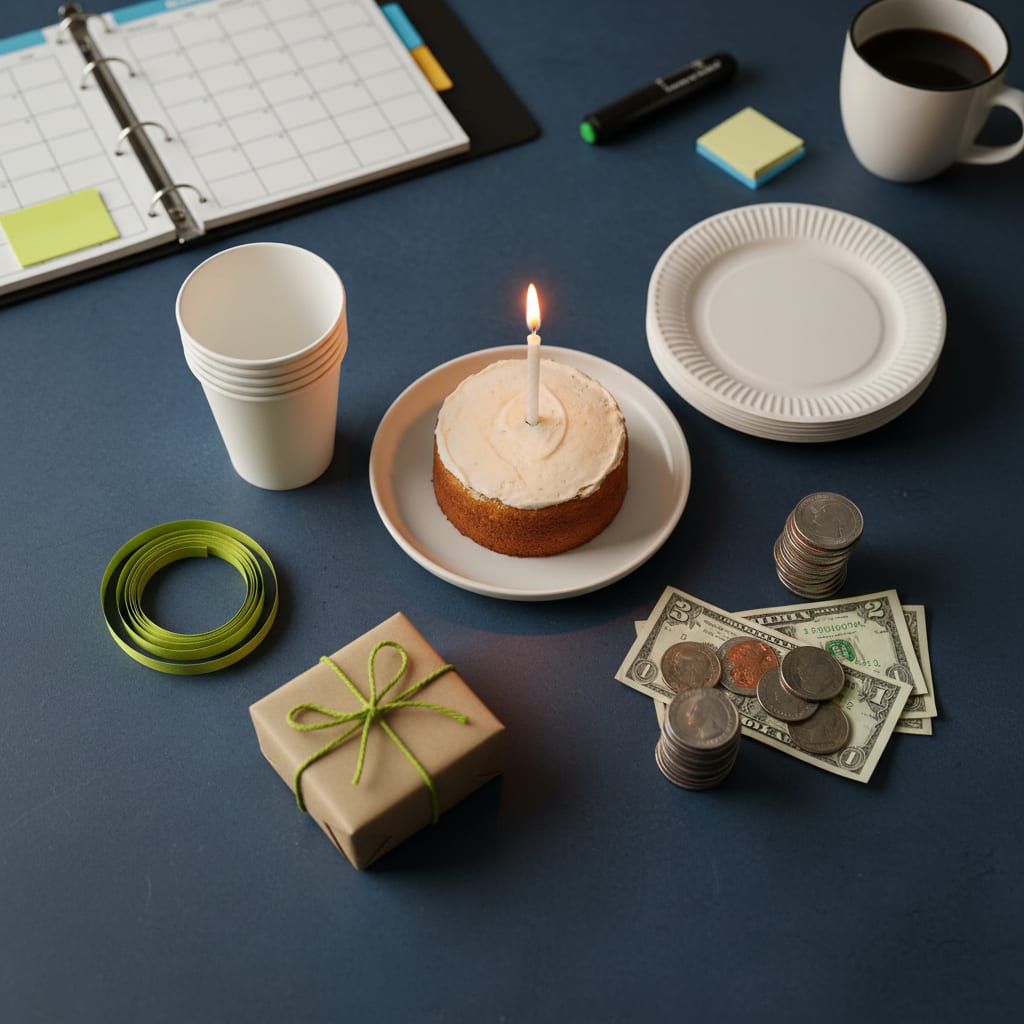
A kid birthday on one income works when you set the total number first and design backward from it — cap, guest count, venue decision, gift budget, in that order. Almost every blown birthday budget comes from doing it in reverse: picking a venue, then a guest list, then discovering what it costs. This post is the money layer only. Not theme ideas, not decorations, not games — just the math that decides what your kid’s birthday costs and how to keep it from quietly becoming a car payment.
Step 1: set the cap before anything else
Pick one number per kid, per year, and write it down somewhere you’ll see it when a venue quote arrives. Two ways single-income households usually set it:
- The percentage rule. A birthday is a want, not a need — so it comes from whatever slice of your monthly budget is already labeled discretionary. If your budget has no discretionary slice this year, the cap is genuinely small, and that’s information, not failure.
- The sinking-fund rule. Divide the cap by 12 and move that amount to a separate savings bucket monthly. A $180 party costs $15 a month and never touches the birthday-month paycheck. This is the same envelope logic as the rest of the single-income budget system, and birthdays are the easiest place to start because the date never moves.
Set the cap to include everything — food, cake, venue, favors, decorations, and your kid’s gift. Partial caps are how people end up $120 over: the party stayed on budget and the present didn’t.
Step 2: know the four costs that actually blow it
Every over-budget kid party I’ve seen ran over on one of these:
- Guest count. This is the master variable. Venue packages price per child, and food, favors, and cake all scale with heads. The classic guideline — the child’s age plus one — exists because it keeps the count controllable, and it’s also about the number of kids one adult can supervise alone.
- Venue. A booked venue converts a variable-cost party into a fixed-cost one with a minimum you can’t undercut. That’s not automatically bad (see the labor math below), but it’s the single biggest line.
- Favors. The least remembered, most reliably wasted spend at any kid party. A single decent item per guest, or a take-home from the activity itself, or nothing at all — a party is not a gift exchange in both directions.
- The gift itself. Often the true budget breaker, because it’s emotional and it’s usually decided separately from the party. Put it in the cap, and use cost-per-use math to pick it: the $60 thing used weekly for two years beats the $60 thing abandoned by March.
Step 3: the venue-versus-home math (be honest about labor)
The blog-standard advice is “just have it at home, it’s free.” At home is cheaper in dollars and more expensive in you, and when you’re the only adult, your capacity is a real budget line.
A rough, hedged comparison — prices vary enormously by region, so treat this as a shape and get local quotes:
| Home party | Booked venue | |
|---|---|---|
| Cost driver | Food, cake, supplies — roughly $6–$12 a head is a common landing zone | Per-child package price with a minimum head count |
| Setup and cleanup | 4–6 hours of your labor, before and after | Usually included |
| Supervision | You, entirely | Staff runs the activity |
| Risk | Weather, house size, one adult managing ten kids | Very little — it’s their job |
The honest read: home parties win on money and lose on solo bandwidth. If you’re heading into a heavy work stretch or already running on empty — see the burnout signs — a small booked party at the same total cost as a large home party can be the better buy, because it converts money into rest.
The third option nobody markets: a free venue — a park shelter, a library community room, a rec-center room, or a beach. Reservation fees are usually small or zero, the mess isn’t in your kitchen, and the space does the entertaining. This is where the free-activity list doubles as a venue list.
Step 4: a worked example
Say the cap is $180 for a 7-year-old. One version that fits, with typical hedged numbers:
- Venue: park shelter reservation — $0–$25 depending on your parks department
- Food: pizza and a fruit tray for eight kids and a few adults — roughly $50–$65
- Cake: grocery-store sheet cake or a boxed mix and $6 of frosting — $10–$30
- Drinks and supplies: juice, cups, plates, a tablecloth — around $20
- Favors: one item per guest, or skip entirely — $0–$20
- The gift: the remainder, deliberately, not the leftovers — $40–$70
Two structural moves matter more than any single line. Fewer guests, better activity beats more guests and thinner everything — kids remember what they did, not the quantity of attendees. And off-peak timing cuts food costs a lot: a 2pm party is snacks and cake; a 5:30pm party is dinner for a dozen people.
Step 5: split it with your co-parent, in writing, early
Two households turns a birthday into a coordination problem before it’s a money problem. The versions that work:
- One party, split cost. Agree on the total cap and the split ratio before invitations, in a message you can both look back at. Don’t relitigate it at the cake table.
- Two smaller celebrations. Common when the parents can’t share a room comfortably. Set a per-household cap so it doesn’t turn into an unspoken bidding war — kids read that faster than adults think, and it does not land as love.
- Split by category. One parent takes the party, the other takes the gift. Cleanest option when a cash split is contentious, because nobody audits anybody.
Whatever you land on, put the date, the guest cap, and who’s paying for what in the shared calendar the same week you decide. Written beats remembered, always.
FAQ: birthday budgets on one income
How much should a kid’s birthday party cost?
However much your discretionary budget can carry without borrowing — that’s the only correct number, and it varies wildly. Practically, plenty of well-loved parties land in the low three figures all-in, and plenty of good ones cost under $50 at a park with six kids and a cake. Set the cap from your budget, not from what other families spend.
How many kids should I invite?
The child’s age plus one is the standard guideline, and it holds up well for solo hosting — it caps both the cost and the number of children one adult can actually supervise. For older kids, “one friend per year of age” also gives you a clean, unarguable answer to the invitation-list negotiation.
Are party favors worth it?
Financially, rarely. If you want them, make the take-home be the activity — the thing they decorated, planted, or built — so one cost covers both entertainment and favor. Skipping favors entirely is completely normal and nobody’s parent has ever mentioned it.
How do I keep gifts from wrecking the budget?
Decide the gift amount when you set the cap, before your kid produces a list. Then buy one substantial thing instead of several small ones, check resale and secondhand for big-ticket toys and bikes, and tell grandparents specifically what’s needed — unguided gift enthusiasm is how houses fill up with plastic and budgets go sideways.