Cost Per Use: The Math That Beats Cheap Shopping
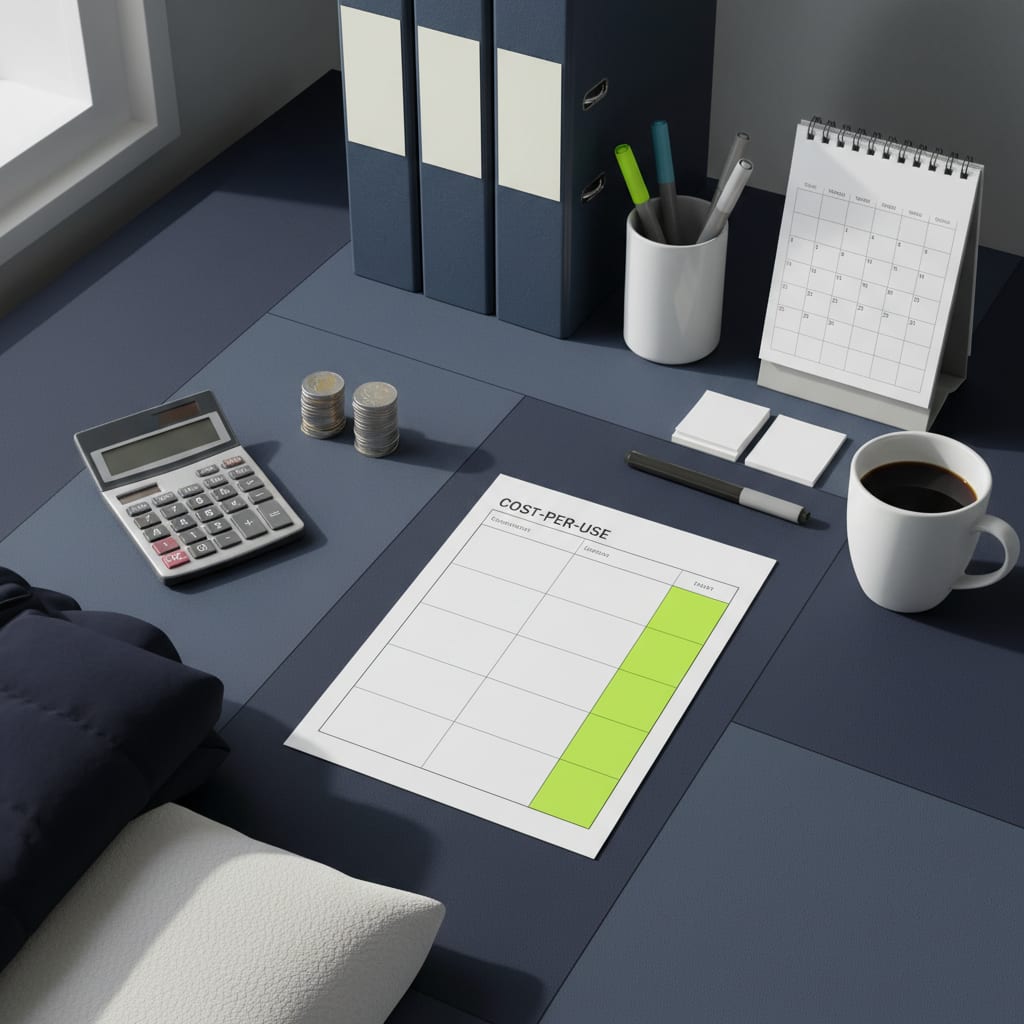
Cost per use is simple division: price of the thing, divided by the number of times it will actually serve you. It’s the math that reveals when the “cheap” option is quietly the expensive one — a $20 pillow rebought every year can cost more per night than a $188 pillow that lasts a decade — and it’s the closest thing to a cheat code a one-income household gets. But it comes with a catch the buy-it-for-life crowd skips: the math only works if you have the cash up front. Here’s the formula, a worked example, and the honest rules for when to ignore it.
The formula (and the only three numbers in it)
Price ÷ (uses per week × weeks of realistic life) = cost per use. That’s it. The trick is being honest about the third number — not the lifespan the marketing implies, but how long the thing serves at full usefulness in a real house with real kids. A spreadsheet cell works; the back of the electric bill works too. This is the same discipline as the real-number budget: you run the math on the numbers you have, not the numbers you hope for.
A worked example: the bed
Bedding is the perfect test case because you use it every single night — the denominator doesn’t get better than 365 uses a year — and because the price range is absurd: pillows run from $6 to four figures.
- The cheap lane: a roughly $20 big-box pillow, replaced yearly (they flatten — the fold test doesn’t lie), is about 5 cents a night. Except it spends half of each year already flat, so you’re really paying 5 cents for a good pillow half the time.
- The buy-once lane: a quality down pillow like Lincove’s Original European Down — 600 fill power goose down, cotton shell, around $188 — kept in a $30 zippered protector, is a many-years purchase. On a conservative five years, that’s roughly 10 cents a night, and falling every year it survives.
The churn in that cheap lane is measured, not guessed: Lincove’s survey of 13,425 Americans found 59.2% of the restless-sleep group had gone through three or more pillows in three years, and every one of those rebuys resets the denominator to zero — which is how “cheap” quietly becomes the expensive lane.
Read those numbers again, because they cut both ways. The premium pillow is not dramatically cheaper per night — it’s a nickel-a-night upgrade to never sleep on the dead version. Cost-per-use math doesn’t always crown the expensive thing; sometimes it tells you the cheap thing is fine. (Their down-alternative version at around $69 is the middle path — washable, hypoallergenic, and the one I’d actually point a tight-year budget at.) What the math always does is replace vibes with a number, and numbers are how single moms win arguments with stores.
Where the math points “buy once”
The pattern: high frequency + slow obsolescence + you, not a child, as the user. Your own mattress, pillow and winter coat. The vacuum. The car seat you’ll thread through two kids. The stockpot. These get used hundreds of times a year for years, and quality versions genuinely last — the denominator does the work.
Where the math lies to you
- Anything a kid grows out of. Shoes outgrown in five months have a hard cap on uses; buy mid-range. The exception is hand-me-down chains — a second kid doubles the denominator.
- Anything trendy, including for you. A “lifetime” item you stop liking in a year is a one-year item at lifetime prices.
- Low-frequency items. The waffle maker used four times a year never wins this math, at any price.
- And the big one: cash flow. A $188 pillow at 10 cents a night is only cheaper than a $20 pillow if the $188 exists. Going into card debt for a buy-it-for-life item torches the math instantly — interest is a use-tax on every single night. The bridge is a sinking fund: the 52-week challenge exists for exactly this kind of planned, unhurried upgrade. One good thing a year, paid in cash, in the order your actual life uses them.
The one-income version of “investment piece”
Solo-budget honesty: this framework is not permission to buy luxury things, it’s a tool for ranking upgrades. Mine says: my mattress and pillow before my sheets, my winter coat before my handbag, the kids’ car seat quality before the kids’ clothing labels. Run your own list coldly. And when the math and the bank account disagree, the bank account wins — the math will still be true next year, and the fold test will tell you when it’s time.
FAQ
What does cost per use mean?
It’s the true price of an item spread over its real use: price divided by total uses. A $100 coat worn 200 times costs 50 cents a wear; a $30 impulse top worn twice costs $15 a wear. It turns “can I afford this” into “what does this actually cost me.”
Is buying expensive stuff really cheaper in the long run?
Sometimes — for high-frequency, long-life items you personally use daily, quality often wins per use. But the gap is usually smaller than the buy-it-for-life crowd claims, it disappears entirely if you finance the purchase, and it never applies to things kids outgrow.
How do I buy quality items on a single income?
Sinking funds: name the upgrade, divide the price by the months until you want it, and automate that amount. Cash-flowing a planned $188 purchase over six months keeps the cost-per-use math honest — debt is the only thing that can make a good purchase expensive.
What should I upgrade first on a tight budget?
Rank by hours of use: your mattress and pillow (thousands of hours a year), work shoes, the coat you wear daily, the cookware you use nightly. Buy the boring, high-hours things well and the glamorous, low-hours things cheap — never the reverse.